
Although, unfortunately, resistance to treatments is a common situation with all parasites, it can be very challenging both for koi keepers trying to protect their stock and treat infected fish, and for veterinary pharmaceutical companies who are always trying to develop ne effective treatments, with a limited range of available anti-parasitics.
Although initial studies suggested that only one resistant fluke species, Gyrodactylus sprostonae was involved, as the problem has developed it is clear that there are other new resistant flukes now appearing on the scene. Although misuse of treatments such as persistent underdosing can lead to resistance, there is a strong likelihood that some of these resistant species will have been imported. Microscopic identification of these parasites is not always straightforward.
Gyrodactylus sprostonae
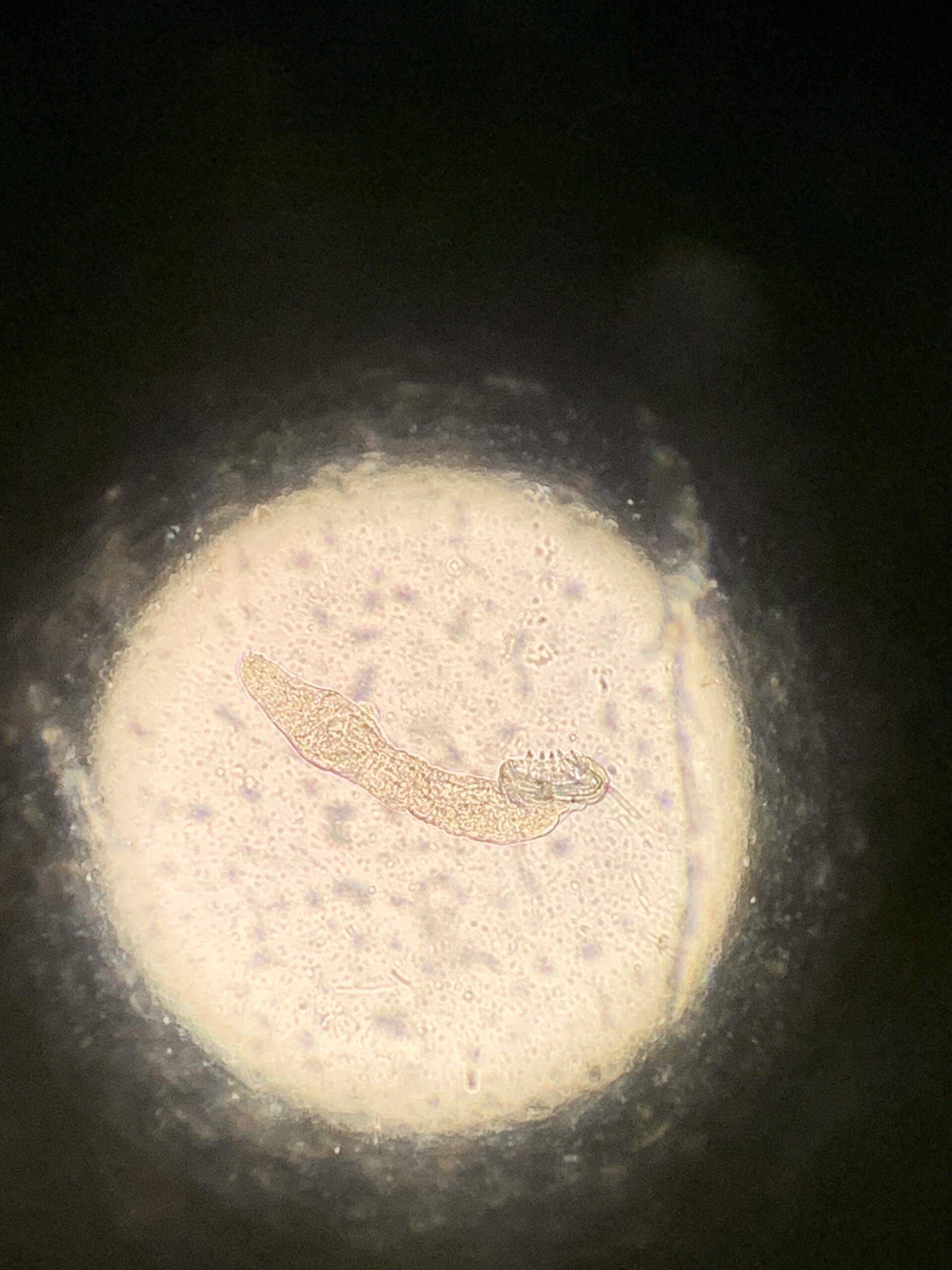
Gyrodactylus sprostonae attached to the host
Other resistant flukes have included these two distinct species.


To date, it’s only skin flukes, Gyrodactylus species, that seem to be causing the problems, but they can be devastating when they strike. One specific species has been identified, Gyrodactylus sprostonae, but others have made their appearance too.
They are live-bearing, which does make treatment a little easier than egg-laying flukes, since once they have been destroyed that should be the end of the problem. However, it will come as no surprise that treatment of these parasites can be tricky for a variety of reasons.
If you try treating them and the treatment doesn’t work, the main factors to consider are:-
- Pond management
- Treatment systems/approaches/techniques
Pond management
Are there any pond factors which could be interfering with the treatment? There are a number of possibilities, depending upon the various types of pond hardware and how they are used. Many factors may interfere with treatment, for example:
Agitation of the pond water – fractionating – which causes separation of the constituents of the medication and preventing the treatments being made available in the water to the parasites.
Ultra-violet filters can also cause degradation of some of the active ingredients of fluke treatments – not all of them, it depends on the wavelength and wattage.
Filter media are another potential issue – we all want sparkly clean water, but certain types of media are very good at removing and locking in small particles from the water, which may include the active ingredients of some treatments.
Remember, some dechlorinators can remove treatments too.
Thus the combination of water agitation, UV filtration and various media as well as other factors can all contribute to rendering the chosen treatment ineffective.
Pond hygiene can also play a part – flukes like to find somewhere to hide (they have even been known to hide under fish scales!) so keeping the pond as clean as possible, paying attention to little nooks and crannies will help, such as joints in the pipework. However, this is something that is easier said than done – take bottom drains for example – better to purge before treatment.
To summarise, what keeps your pond water clean and free from waste products can play a part in interfering with the active ingredients of fluke treatments.
Treatment systems/ approaches/techniques
There are 4 basic points which are really important.
- Read the instructions on the product label.
- Know the size of your pond.
- Check your dosage calculation.
- And most important – Adequately QUARANTINE new arrivals to prevent the introduction of these unpleasant parasites in the first place!!
Are the flukes you are trying to treat truly resistant to the active ingredients in the product you are using? Or is it a pond factor?
One way to find out is as follows:-
The principle is quite simple, although it may seem to be a bit of a nuisance. However it is a question that needs to be answered in order to solve your fluke problem and restore a comfortable life to your fish.
The easiest way to decide if it is a fluke resistance or a pond management issue is to do a tank trial.
Fill a suitable sized tank or appropriate container with fresh tap water, not from the pond (use a simple liquid dechlorinator such as sodium thiosulphate since some dechlorinators can actually remove the medicinal products too) and put in an airstone. Gently stir the correct dose of a treatment in a small clean container of the test tank water and pour into the tank. Leave for 48 hours before you put any fish in to give the active ingredients time to fully dissolve.
Visit FLUKE-SOLVE® AQUARIUM | Fish Treatment Ltd (fish-treatment.co.uk) and scroll down the page where you will find a diagram of how to accurately measure a small dose of Fluke-Solve or Fluke-Solve Plus.
Take a couple of infected fish (confirm the presence of the parasite with a skin scrape) and put them into the treated tank. Do not feed the fish – they will be fine for a couple of days. Check the fish in 48 hours and see if the product has worked. If the fish are then clear, it’s a pond problem. If there are just a few flukes left, leave for another 48 hours before scraping again as we have found that some of the newer resistant flukes can take a little longer to die. but if the flukes are still present it is likely to be resistance.
However, when choosing a fluke treatment, there are some factors to consider.
- Is there independent scientific proof that the active ingredient will kill flukes? Since the point of a fluke treatment is to kill the parasites, there is a much greater chance of doing this if the active ingredient dissolves in the pond water while retaining its original structure and activity.
- In use stability – how long does the active ingredient stay effective in the pond?
- Temperature – what is the effective temperature range for the product?
- Is it also effective in the presence of salt?
As far as Fish Treatment products are concerned, all of these questions will have been answered by the company researchers as they would have been addressed during product development and are important factors in the selection of an effective product medication.
To summarise, resistant flukes are likely to remain with us, affecting koi carp and other susceptible fish. However it is important to make sure all the other pond factors are taken into account when using a treatment.


